24 August 2005

Interesting Orbital Space Tourism Numbers

In the light of Virgin Galactic's recent announcement of the possibility of doing an orbital "SpaceShip 3" if their SpaceShip 2 is succesful enough, I ran into a rather interesting bit of information this afternoon regarding orbital tourism. I had been poking around a NASA website that had copies of the final CER reports from the various companies that had been picked for the round one paper studies for the CEV. I saw some other interesting ideas (and noticed some interesting trends) that probably deserve their own post when I get time, but the thing that really stuck in my mind was from t/Space's presentation [Note: This is a ~3MB PDF file, the part discussed below starts on page 44 if you want to follow along--Jon]. Most of the stuff in their presentation was covered by them at the RTM VI conference, but the part they hadn't mentioned was a study performed on the prospects of orbital tourism.

On doing a little further research, I'm no longer clear if they (or Futron) did additional research on the topic, or if these numbers were just a reanalysis of the original results of Futron's 2002 Space Tourism Market Study. However, the results are still interesting. I happened to have a .pdf copy of the Futron study on my computer, so I just reread all the sections talking about orbital tourism. What appears to be the key difference between the forecasts that Futron came up with for orbital tourism, and the numbers that t/Space did had to do with the following key assumptions:
  • Futron assumed that the Soyuz would be the only available space tourism vehicle between now and 2015

  • Futron assumed that the price would start at $20M and decline gradually to $5M per person over the next 15 years

  • Futron assumed that all flights would require 6 months of training in Russia

The key thing that t/Space noticed was that as the price dropped, the interest rises rapidly. As they point out, while there are only about 6,000 houses worldwide that have a net value of $200M or more, there are 100,000 with a net value of $20M or more. Futron noted that for suborbital flights, most wealthy people are only willing to spend about 1.5-5% of their net value on the flight, but that for orbital flights, the amount Tito and Shuttleworth paid was closer to 7-10% of their net value. Truly wealthy people usually only have a small amount of their value in readily liquid assets, most of their value is in things like stocks, bonds, houses, rental properties, etc. The key as t/Space saw it was to reduce the price far enough that a much larger market segment would be interested.

Based on the idea of a lower-cost vehicle (ticket price $1-5M), that was designed to be more spacious and comfortable, operated out of the US, and requiring only 1 month of training, and capable of flying as often as they had passengers, they used the results from the Futron study to come up with an estimate of demand and revenue. They showed results for both the 1.5% and the 5% of net value levels (instead of the 10% assumed by Futron), and for ticket prices of $1M, $2.5M, and $5M. They didn't include a deduction of interest in latecomers due to the "pioneering reduction" like Furton did, and they assumed that flying from the US would increase the worldwide demand by the same amount as it would the US demand (Futron assumed only North Americans would be more likely to fly if the vehicle were American). The S-curve approach they used to model acceptance over time seemed a little different too. While the initial ramp up was rather slow at first(only 1% of the total pool of those who would be interested were assumed to fly per year), the percentages they assumed toward the far end of the column seemed way too high. 97% of those interested flying every year? Yeah right. Admittedly, the number of high net worth households should increase substantially over the next several years as nations like China, India, and Russia join the first world, but I still would only take anything much past 10 years with the appropriate sized grain of salt.

All that said, the results were rather impressive.

Assuming the worst case numbers (that most people would only spend 1.5% of their total net value on the trip), the total first year revenue was between $40M and $340M, with the lower ticket prices ($1M and 2.5M) being much higher revenue than the $5M. By 2015, anywhere from $350M to $3B in revenue per year was likely. That's starting to get rather respectable. That's also still assuming only 8% of the total available people who fit all the requirements would be interested.

One interesting piece of data. If you assumed the 5% of net value level of interest, the highest revenue predicted was for the $2.5M ticket, while if you assume that people will only pay 1.5%, the $1M ticket is much better. What that seems to mean is that as orbital spaceflight becomes more common, ticket prices will need to drop in order to increase revenue further to offset the "pioneer deduction" effect Futron mentioned.

Anyhow, I just thought I'd draw attention to this analysis. While it assumes several things that don't exist yet (low cost, high flight-rate RLVs being the biggest one), it really does show the potential scale of the market involved. If a company can develop an RLV for a cost low enough that they could still offer $1M tickets and still make money, they will likely do very, very well.

I wonder how these numbers would play out for a commercial lunar flyby or for a lunar landing....

07 February 2008

LM/Bigelow Atlas V Deal

For those who didn't see it on Hobbyspace, I got interviewed yesterday by New Scientist about the recent LM/Bigelow announcement. All in all it was a pretty good article (though apparently we might need to update our website to reflect the fact that we haven't been in Santa Clara for over a year and a half...). I had a few other thoughts about the announcement that I figured might be worth sharing, for what its worth.

In the quote they selected for the article, they mentioned my question of "will they be able to drum up enough demand to justify the flight rates they're talking about." Here were some of my thoughts that I shared with David Riga (the author of the New Scientist piece), that didn't make the cut:
If he were just running an orbital hotel (he isn't), I'd be very skeptical. Instead I'm somewhere between skeptical and guardedly optimistic. While there haven't been large numbers of takers for flights on the Soyuz, what Bigelow's offering is fundamentally different. Flight opportunities are frequent (which is critical for most microgravity research programs--imagine trying to run an R&D lab that you could only visit once or twice a year!), the situation is more customer friendly, training would likely be more streamlined (I hear that for Soyuz training the "passenger" is actually more of a third crew member than an honest-to-goodness passenger), etc.

It'll be interesting to see if he can pull off his idea of forming an international astronaut corps for countries that don't have their own space program. It wouldn't have all the usual glory of having your own national launch system, but it also wouldn't have the waste of it either. Countries like the UK could look at it as a smart and low-cost way of doing a manned space program--why reinvent the wheel when you can just buy a ticket and focus on doing something in space instead of blowing billions just getting there?
Also, the title of the New Scientist piece is somewhat misleading (though David may not have had anything to do with the title). There are some major hurdles for using Atlas V to fly people to Bigelow's station--it's just that most of the major risks don't lie with "man-rating" the Atlas V (or whatever you want to call making reasonable adaptations for flying a capsule on an ELV). Continuing with some more thoughts that didn't make the cut (yeah I wasn't expecting David to use every word of my several page response...):
Most of the challenges fall into two areas: developing a market at the pricepoint Bigelow can offer with existing transportation systems (like a "man rated" Atlas V), and finding a capsule developer who can raise the money and technically execute on doing such a capsule. I think the technical risk for both parts is relatively low--this has been done before even if there are still some improvements needed over previous systems (Mercury, Gemini, Apollo, Soyuz, etc) to make it commercially viable. Most of the risk is on the marketing and financing side of things.

If Bigelow is able to start signing up high-visibility customers though, look to see that change. Once there looks like there's going to be enough demand to justify a capsule project, I think it'll be much easier to raise money for [developing] it.
Lastly, discussing whether I thought that the Atlas V was a good choice for Bigelow, I said:
I think at the moment they're a pretty good choice. The good news is that with SpaceX also hopefully getting into the launch business soon, that'll provide the competition Bigelow needs to keep prices low. Obviously, it would be great if there were high-flight-rate commercial RLVs instead, but those really need a proven market in order to justify the funds needed to pull them off. So short term, I think this may be Bigelow's best bet. In the longer term, it'll be up to LM to find ways
to keep themselves competitive.
To elaborate on this last point a bit, the price points Bigelow has been talking about (~$15M per person for a 1 month stay) and which a system based off of the existing Atlas V could likely deliver are probably too high for there to be a lot of space tourism demand. Fortunately, as Bigelow has mentioned a lot of times, he isn't running a space hotel. In order to really start getting to the elastic portion of the demand curve, the price tag would probably need to be a bit lower--on the order of $2-5M per ticket (according to some reanalysis of the old Futron Space Tourism study that T/Space did a few years ago that I discussed in this old blog post). It may not actually be as impossible for LM to deliver numbers at least on the high-end of that scale as I used to think (they have some possible tricks up their sleeve if the demand for Atlas V flights was high enough to justify the investment), and if Bigelow can actually deliver on demand for 80+ people to his station in a given year it might also be enough to close the business case for a high-flight rate, small RLV. But neither of those options are likely to happen right away. So, while someone like Space Adventures could probably rent some of his facility for space tourists, at the price point they are talking about, I'd be surprised if they could fill up more than 1-2 of the 12 targeted flights per year with actual "space tourists".

That leaves Bigelow's "sovereign" and "prime" customers to make up the rest of the 10 flights worth of demand. Admittedly one should note that not all of the 12 flights per year are going to be people--I'd imagine that at least one will be consumables, cargo, reboost propellants, etc. And on some flights I imagine that some of the passenger seats might be exchanged for experiments, research hardware/raw materials, and other commercial cargo.

The good news is that if they're really providing 12 missions per year, that's a monthly flight. While that still isn't phenomenally great for a microgravity research program (see Ken's last post, and my last space post and these posts from the ACES conference two years back for why flight rate is important for such programs), it's substantially better than the existing state of practice. As was stated in the first of those two ACES posts, when people know that there's going to be a flight every month to the station, it's a lot easier to slip last minute experiments or small hardware on-board at the last minute. Scientific research often lives or dies on iterations--on how fast you can experiment, analyze, reformulate, rehypothesize, and get to your next experimental step. What this means is that while 12 flights a year at $15M per seat isn't perfect for orbital microgravity research, it might actually be good enough to start generating some real demand--ie the "tipping point" where orbital microgravity demand starts picking up might be a little higher than orbital tourism, and possibly high enough to fill up at least a chunk of those 10 remaining flights.

But like the space tourism demand, that demand is only going to be able to grow if Bigelow can provide enough demand for the rest of those flights. Which brings us back to the "sovereign" customers that Bigelow has mentioned on several occasions. The idea being that this would provide smaller countries a much cheaper way to get involved in manned space flight. At least one country I know of might be in an ideal position to take the lead on this venture: the UK.

As Duncan over at the Rocketeer blog has mentioned on several occasions, this might be a good way for the UK to get back into manned spaceflight as they have recently been discussing more seriously. It's interesting to note that the premier suborbital tourism venture involves a US launch provider and a British operator, so the idea of the UK buying tickets to a US owned commercial station on US owned and operated launch vehicles could be framed as being the new way of doing things. As I mentioned above, by letting someone else spend the money on the destination and the transportation, the UK could focus on actually doing something useful with people in space, instead of blowing so much money on the first two categories that they have little left for actually accomplishing something. This would be a very forward-thinking thing for the UK to do. And if they took the lead in signing up for such a program, it is very feasible to believe that you would see other nations following their lead. I'm thinking of other Anglosphere countries like Canada, Australia, New Zealand, South Africa, and possibly even India. It wouldn't take too many of them running small low-cost astronaut corps and doing their own research projects on Bigelow stations before you could start providing enough demand to see those kinds of flight rates. Or at least it doesn't seem to unrealistic to imagine it.

So, at least on the surface it might be possible for Bigelow to pull this off--but he's going to need to sign up some high profile customers sooner rather than later. In the medium and long term, if Bigelow is able to provide enough demand for that many Atlas V flights, LM is going to have a lot of competition. From SpaceX and from other corners. But that's a problem that I'm sure we would all love to have...

Labels: , , , ,

23 September 2006

Atlas V for Space Tourism?

Ok, last week, when I first got sent the link to the Atlas-V man-rating paper, I noticed that they mentioned using Atlas V for space tourism. I started writing this blog post Thursday morning before the big Lockheed/Bigelow announcement, but hadn't had a chance to finish my analysis. I mentioned that I would try to finish this though, so here's what I've got:

When I first noticed the idea of using Atlas V for space tourism, I was fairly skeptical about its practicality, but I figured it'd be worth taking a look at the numbers and seeing if there is an even remotely plausible way they could make it work.

So, for this excercise in numbercrunching, we're going to use the rehash of the Futron study that t/Space did way back in their CE&R report that I talked about on the blog last year (relevant numbers start on page 44 of the post). The Futron study isn't perfect, can't tell us how many people will actually buy, and has all the caveats and exceptions you would expect from any marketing study. You can't prove a business will succeed just based on analyzing market studies, but you can at least get a feeling for if the idea is even feasible.

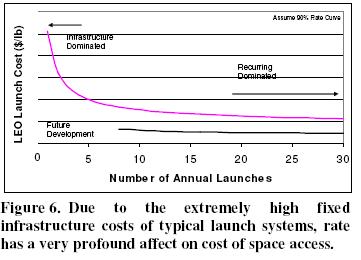
Ok, so first let's look at pricing. How cheap could Lockheed really afford to sell tickets on an Atlas V? The first key piece of the conversation is the point made in one of the Lockheed papers (which for some reason is no longer linked-to from the main Atlas-Yesterday, Today and Tomorrow page): very low flight rates drive costs up substantially. While it's fairly well understood that higher flight rates are better, I think that Figure 6 from that paper illustrates the point rather well:

A lot of people have commented on how Atlas V's "cost" $138 million each right now, and that thus they would be way too expensive for commercial tourism. But this ignores the effect of flight rate on costs and prices. Basically, there's certain fixed costs that have to be paid every year regardless of if you launch once, twice, or twenty times. You need to keep engineers on staff, pay for upkeep of your pad and factory, pay leases on your manufacturing equipment, etc. At very low flight rates, all of that has to be divided up between only a few launches. As more and more launches occur, the cost per launch ends up trending downward to the marginal cost per flight, which for EELVs includes the marginal manufacturing cost of one extra vehicle. One thing to note is that even the marginal cost goes down as you make more of something due to "learning-curve" effects among others.

So, while the average Atlas V 401 mission runs about $138M right now, if they got back up to the flight rate originaly envisioned (about 6-8 a year IIRC), the prices would likely be able to drop back to the ~$72M per launch that they were originally offering. It's interesting to realize that if they were offering the Atlas V 401 at $72M, it probably means that their internal marginal cost per booster is much less than that number. Possibly as low as $30-40M. So, at current flight rates, they're charging about $138M each (for 2-4 per year), which would likely drop to $70-100M if they got back up to 6-8 flights per year, and possibly as low as $50-70M each if they got up to 15-20 flights per year. If they had sustained demand for 15-20 flights per year, they could probably reinvest some money into more streamlined manufacturing and operations (ie adding more automation, building extra pads, etc), and might be able to push those numbers down a little bit farther. However it's really not clear how much lower than $50-70M they could push their prices without impacting their bottom line.

For comparison, their 2-4 launches per year is probably netting them somewhere between $300-700M per year (average mission price of say about $175M). Aren't they also getting a $500M per year subsidy from DoD every year just to stay in the launch business? So that means they're making $800-1200M per year off of their Atlas V line. At $70M in revenue per flight, that's $1.4B per year (unless they can somehow trick the DoD into continuing to pay them a subsidy for their existance--don't laugh if anyone can pull that off, it's Lockheed), which is only a little better than they're making launching 4 flights per year. Now, if that subsidy went away (say as part of the ULA merger or something), then the $1400M in revenue would be a big improvement over the $300-700M they're making before subsidy.

So anyhow, I think there's a decent case that if LM really could get most or all of the Bigelow Sundancer/Nautilus business, that they could get the Atlas V price down in the $50-70M range, and possibly another $20M for the capsule leading to a roughly $10M ticket price assuming the 8-person capsule LM mentions, with 1 crew and 7 paying passengers.

So how much private demand is there likely to be at that price? Unfortunately the numbers don't look very good. As t/Space points out, wealthy individuals are unlikely to spend more than 1.5-5% of their net worth on a vacation. What that means is that for a $10M ticket to be less than 5% of your net worth, you need a net worth of greater than $200M, which puts you on par with Tito and Shuttleworth. According to the numbers at the time of the Futron study, there are about 6000 households in the world with that much net worth or greater. Once you factor in the percent that are likely to be interested, that are in good health, and all other factors, you're down to a probable market of around 1000 people. In order to drive demand up enough to drive your price down to the $10M range, you need 15-20 flights per year. If say 10 of those per year were passenger flights, that would require 7% of the total potential customer base per year to want to fly. While that is possible, I'm not sure how realistic it is.

In order to really get demand high enough that that kind of flight rate isn't unrealistic, they'd need to drop their ticket price by another factor of 2 down to $5M. At that rate, you could realistically see dozens of people flying per year in the relatively near future. However, at $5M per seat, that would imply that Lockheed could sell an Atlas V flight and the accompanying passenger vehicle, at a total cost of less than $35M. Somehow I don't see that happening.

So yeah, Atlas V could possibly be a decent vehicle for space tourism, but probably only if it had no competition, and a lot of luck in marketting rampup. Not to mention dealing with their corporate culture issues--transitioning from a business that makes most of its money off of government contracting to one that is mostly commercial oriented is not always an easy or smooth process.

Anyhow, what do you all think?

22 February 2006

Some Thoughts on SMED, EELVs and Lunar Tourism

For a long time in the car world, due to the high setup times inherent in some of their equipment (like the massive multi-ton dies they'd use for panel stamping) and other factors, car manufacturers would use a "batch-and-queue" style manufacturing system. The logic went that since it took a full day sometimes to change from one model to the other (due to for example, needing to say swap dies, remount the new die, and then precision callibrate it) that it made sense to switch models as infrequently as possible. So, if you were producing car models A, B, and C on a given production line, you'd produce all the A's you think you'd need for a month, then proceed to B's, then to C's. The problem is that this is wasteful, takes up a lot of space, increases the odds of damaging goods, and requires a lot of capital to be tied up in intermediate stages of production where it isn't actually generating revenue. It also depends a lot more on forecasting, computerized inventory, and all sorts of other things that tend not to work very well.

When the Toyota Corporation was getting back on its feet after WWII, they realized that doing things that way was a luxury they couldn't afford. Most people who know anything about manufacturing have heard the terms Just-in-Time or Lean Manufacturing. With Just-in-Time, the goal is to reduce inventory levels as far as possible, so that production signals from the end customer can tell you when to produce what, instead of trying to guess and forecast, and then end up producing lots of crud that nobody wants to buy. In order to do that though, something had to be done about those huge sheet metal presses. There's no way you can run on only a few pieces of work in process inventory if it takes a day to switch dies. So Shingo decided to set an audacious goal: he wanted to be able to reduce the setup time for one of those dies from as much as 24-36 hours down to 1 minute. The disturbing thing is that he actually went on to do it. The technique he developed, called Single Minute Exchange of Dies or SMED for short, is one of the key enablers to modern Lean Manufacturing. All of the sudden when swapping from model to model to model only takes about a minute each, you could put that machine back into the main line. You could swap dies between each and every panel if you wanted. You no longer needed to produces weeks and weeks of panels at a time, because you could build precisely what was in demand at that time. In short, it was a really big deal. RLV operators would be well advised to pick up a copy or two of Shingo's book on the topic and take it to heart. I want to see races in a few years where the turn time for an RLV is dropping below 15 minutes.

So, what the heck does this have to do with space?

The way I think this relates is that it shows that the end goal you are working for can often lead to completely different means. Imagine what had happened if Shingo, like hundreds of other talented industrial engineers at the time had merely settled for the "more realistic" goal of dropping the time of die swaps by 50% or even 1 order of magnitude down to a few hours? He probably would have acheived his goal, but in some ways it might have been just as difficult, and yeilded far less benefit. If it still takes you 2-3 hours to swap dies, you're still stuck at least producing weeklong batches if not monthlong ones. I think the reason why Shingo was the one who made so much progress so fast in that field wasn't just because he was a genius, and wasn't because all the other IE's in the US were a bunch of knuckle-dragging neanderthals. I think it's mostly due to the fact that he was actually looking at the problem right. Had any of those other IE's thought "why couldn't we switch dies in only a couple of minutes", I think that they probably would have beat him to the punch. Once you accept the possibility that the goal probably isn't physically impossible, or even silly, you're 90% of the way to a solution. The last 10% may be a real bear, but you're most of the way there once your perspective is right.

Take a look at the EELV program, and even SpaceX. EELV's goal was to reduce the cost of launching satellites for the military from absolutely obscene to merely ridiculous (ie a 50% drop in price IIRC). So, they tried to make some incremental changes to how they build and operate their vehicles. In some areas they've gotten a lot better, but the reality is that they didn't even acheive the modest goals they set out for themselves. It isn't that they're dumb, or malicious, or incompetent. It's just that they set themselves too easy of a goal, so they didn't actually have to think outside the same high-cost artillery box that they've put themselves in over the years.

SpaceX is doing quite a bit better. They wanted to slash the launch cost by 10x. I think they'll pull it off. But that's kind of like cutting time from 24 hours to 2.5 on the sheet metal press. Sure it's a huge improvement, sure it'll make a difference, and sure it is possible. But ironically it may actually be more difficult than going even more radical. I think that SpaceX will eventually figure out some recoverability for their launchers. Might even cut the price they charge customers by another 10-20% compared to a fully expendable vehicle. They might even get up to two 9's of reliability. But if they go for the BFR instead of trying to radically change the Earth-to-Orbit transportation market by going fully reusable...They're probably going to get their lunch eaten. I mean, they could possibly acquire one of the companies that actually develops a fully reusable, high-flight-rate orbital space transport. But the reality is going to be that if they don't keep pushing more and more reusability into their Falcon line, it's going to go obsolete. In fact, I'm not even sure if they can get to there (sufficiently full reusability to maintain competitiveness and marketshare) from the vehicles where they're starting. Don't get me wrong. I think in the near term SpaceX is doing something absolutely wonderful. I think it will change a lot of things in the space industry. But since they took the "how much lower cost can we go based on evolutionary improvements on the status quo" approach, they're already limiting their long-term competitiveness in the ETO transportation market. All it takes is a couple of Shingos to figure out that there's nothing impossible about making a vehicle that is safe enough, reusable enough, and inexpensive enough to drop the launch price by another order of magnitude from SpaceX in order for that to happen. Perspective can be everything.

Also look at lunar exploration and development. For the longest time, I was thinking about how I could reduce the cost of a lunar mission relative to NASA. SpaceDev provided a good example of this a few months back. They developed a plan where they could get back to the moon for about 1/6th of what NASA is likely to spend, and do so in a manner that is actually more flexible (though not neccessarily more capable). Back when I first did my studies on my Prometheus Downport Project, I was thinking along similar lines. I thought "NASA wants to spend many Dirksens on getting back to the moon and building a base, why couldn't it be done for a single Dirksen?" So I borrowed some ideas from George Herbert and came up with a kinda crazy scheme involving one-person landers, crashing TLI/Descent stages, some on-orbit assembly, and some lunar surface staging. The problem was the idea wasn't very practical, and didn't make any economic sense.

A while back though, I started realizing that the nearest term market for lunar access was probably tourism. And that presents a problem. Futron's study pointed out that even for really exotic destinations, most people are only willing to fork out a couple of percent of their net worth on a trip. For something like being the next person to walk on the moon, they might even be willing to fork out a fairly substantial portion, but the reality is the number is likely going to be less than 10-20% at the most. The problem is that the number of people with a given level of net worth seems to be exponentially inversely proportional to the level of that worth. While there's only a handful of people on the earth with a net worth over $10B, there's a huge number of people with net worths of $100M-1B. So, the reality I started running into is that if you want an individual to be able to buy a lunar ticket, the seat price has to be less than $100M, and probably closer to $20-50M before you'll even get a single taker. Listen to the sound of crickets chirping over in line to sign up for Space Adventure's $100M translunar ticket. So the question becomes, how can you get the ticket price for a lunar tourist *in the near-term* down below $50M? Honestly, I'm not 100% sure, but a lot of the ideas I've been harping on I think will be part:
  • Reusable, high-flight-rate ETO transportation

  • On-orbit propellant tranfer and storage

  • Reusable translunar transportation with aerobraking

  • Lots of intermediate space tourism markets like suborbital, orbital, and translunar

  • On-orbit refuelable/reusable lunar landers

  • Maybe ISRU


In the long run, ISRU and maybe some form of high Isp transportation like microwave thermal becomes critical if you want to push the price point to the low single-digit millions numbers where you really want to reach if you want to open a large tourism market. But the point I'm trying to make is that if you actually want a lunar transportation system that is economically useful in any sense of the term, building huge welfare queen Shuttle-Derived hardware is never cut it. Not even a low-cost Russian expendable booster infrastructure will work. Only a radical rethink has any chance.

And in the long run, I think it is just such a radical rethink that has the highest possibility of success.
Weblog Commenting and Trackback by HaloScan.com